
Annuity vs Linear Repayment: Equal Payments or Equal Principal?
Most loan calculators, including ours, assume an annuity: the same repayment every month. In several European countries you can also choose linear repayment, where you pay off the same amount of principal each month and the repayment falls over time. Here is how the two compare.
By the LoanCalm team · Updated
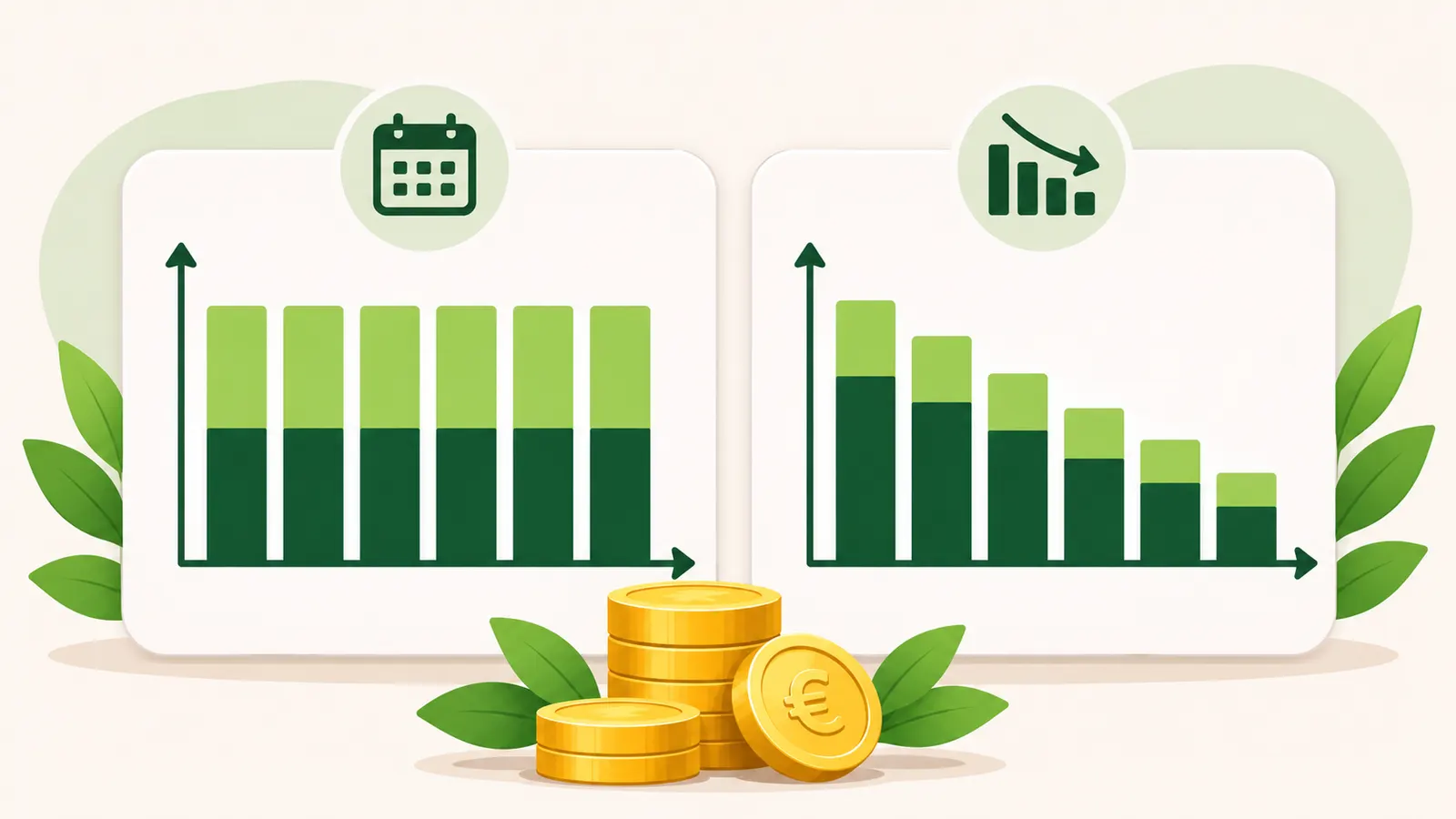
Annuity repayment: the same amount every month
With an annuity, every repayment is the same. Early on most of it is interest; as the balance falls, more of each repayment goes to principal. It is the standard method for most mortgages and consumer loans, and it is what the LoanCalm calculators model.
Local names include Annuitätendarlehen (Germany), annuïteitenhypotheek (Netherlands), annuitetslån (Norway), annuiteetti (Finland), raty równe (Poland), anuitetas (Lithuania) and аннуитетный платёж (Russia).
Linear repayment: the same principal every month
With a linear loan you repay an equal slice of the principal each month, plus interest on the remaining balance. The repayment is highest at the start and falls a little every month.
It is called a lineaire hypotheek in the Netherlands, serielån in Norway, tasalyhennys in Finland, raty malejące in Poland, linijinis grafikas in Lithuania, jafnar afborganir in Iceland and дифференцированный платёж in Russia.
A worked example
Take €200,000 at 4% over 25 years (300 monthly repayments). As an annuity, the repayment is €1,055.67 every month and the total interest is €116,702.
As a linear loan, the principal part is €666.67 each month. The first repayment is €1,333.33 and the last is €668.89. The total interest is €100,333, which is €16,369 less than the annuity.
Which costs less, and which suits you
A linear loan costs less in total because the balance falls faster, so less interest builds up. The trade-off is a higher repayment in the early years, exactly when many borrowers' budgets are tightest, so lenders may approve a smaller linear loan for the same income.
An annuity keeps repayments level and easier to plan. If you can afford more, you can get part of the linear saving by making extra payments on an annuity loan, if your contract allows them without a fee.
- Choose by the repayment you can afford in the first years, not only by the total interest.
- Check whether tax rules depend on the repayment type. In the Netherlands, for example, mortgage interest is generally deductible only for annuity or linear loans repaid within 30 years.
- Ask the lender for the repayment schedule of both types; under EU rules the pre-contract information sheet must describe the repayment type.
Working out a linear loan yourself
The LoanCalm calculator shows annuity repayments. For a linear loan, the first repayment is the amount borrowed divided by the number of repayments, plus one month's interest on the full amount: P ÷ n + P × r, where r is the annual rate divided by 12. Each later repayment is lower by the principal part multiplied by r.
Try it with your own numbers
Sources and further reading
- Directive 2014/17/EU on credit agreements for consumers relating to residential immovable property — EUR-Lex, European Union