Fixed vs Variable Rate Loans in Europe: Euribor Explained
Whether your rate is fixed or follows a reference rate such as Euribor decides who carries the risk of rates rising. Habits differ a lot across Europe: full-term fixed rates are the norm in some countries, while in others most mortgages move with Euribor.
By the LoanCalm team · Updated

How a variable rate is built
A variable rate has two parts: a reference rate that moves with the market, and a margin that the lender adds and that usually stays fixed for the life of the loan. If the reference rate is 2.5% and the margin is 1%, you pay 3.5% until the next reset date.
In the euro area the most common reference is Euribor, a set of rates published each business day by the European Money Markets Institute for periods of one week to twelve months. A loan linked to 12-month Euribor usually has its rate reset once a year, and one linked to 3-month Euribor every three months.
Other currencies have their own references: SARON for Swiss franc mortgages, the Bank of England's Bank Rate for many UK tracker mortgages, and national indices such as IRCC in Romania or the NRS in Croatia. In Poland, the market is moving from WIBOR to a new reference index.
What a change in rates does to your repayment
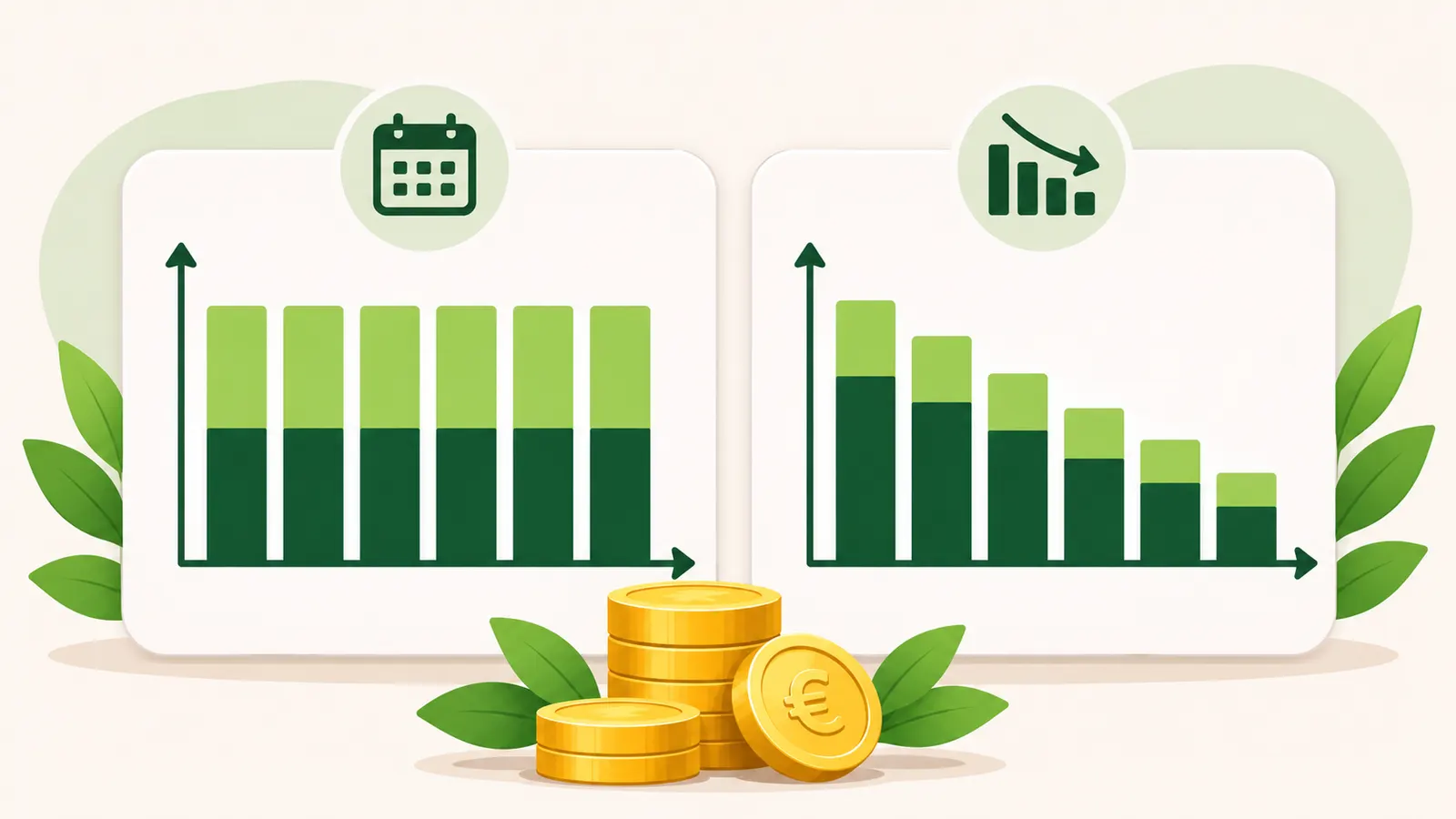
Take a €200,000 loan over 25 years. At 3% the monthly repayment is €948.42. If the reference rate rises by one point, so the rate becomes 4%, the repayment goes up to €1,055.67, and at 5% it is €1,169.18.
That is €220.76 more each month for a two-point rise, before any change in your income. Running your own loan through the calculator at a higher rate is a simple way to test whether you could cope.
Fixed rates and fixed periods
A fixed rate stays the same for an agreed period. Some countries fix for the whole term: most French home loans are fixed until the end. Others fix for a period and then set a new rate: German mortgages often have a fixed-rate period (Zinsbindung) of ten years or more, Dutch borrowers choose a rentevaste periode, Czech and Slovak mortgages have a fixation period of a few years, and UK mortgages commonly start with a two- or five-year fixed deal.
Mixed loans combine the two, with an initial fixed period followed by a variable rate. They are widely offered in Spain, Portugal, Romania and Croatia.
Where variable rates are most common
In Finland most mortgages follow Euribor, commonly the 12-month rate. In the Baltic states housing loans are usually linked to 6-month Euribor. Many Swedish mortgages reset every three months, and most Norwegian mortgages have a floating rate that the bank can change with notice. Spain and Portugal have long used Euribor-linked mortgages, although fixed and mixed loans have become more common.
Things to weigh up
Which type suits you depends on your budget, how long you plan to keep the loan and how much risk you can take. These questions help you compare offers; they are not advice for your situation.
- Could you afford the repayment if the rate rose by two or three points? Test it in the calculator.
- How long is the fixed period, and what rate applies after it ends?
- What does it cost to repay or switch early? Many countries cap these fees, and the cap is often lower for variable rates.
- Does the lender offer a cap on a variable rate, and what does the cap cost?
- Compare offers on the APRC, but remember that for a variable loan it assumes today's reference rate stays the same.
Try it with your own numbers
Sources and further reading
- Euribor® — European Money Markets Institute (EMMI)
- Key ECB interest rates — European Central Bank
- Directive 2014/17/EU on credit agreements for consumers relating to residential immovable property — EUR-Lex, European Union